I am a PhD candidate at the University of California, Irvine, advised by Prof. Syed A. Jafar. I study classical and quantum communication networks, using information theory to understand their fundamental limits. My research seeks to characterize the capabilities and limitations of these networks under models that incorporate quantum entanglement and more general nonlocal resources.
Quantum-Entanglement-Assisted Capacity Gains in Classical Channels with State
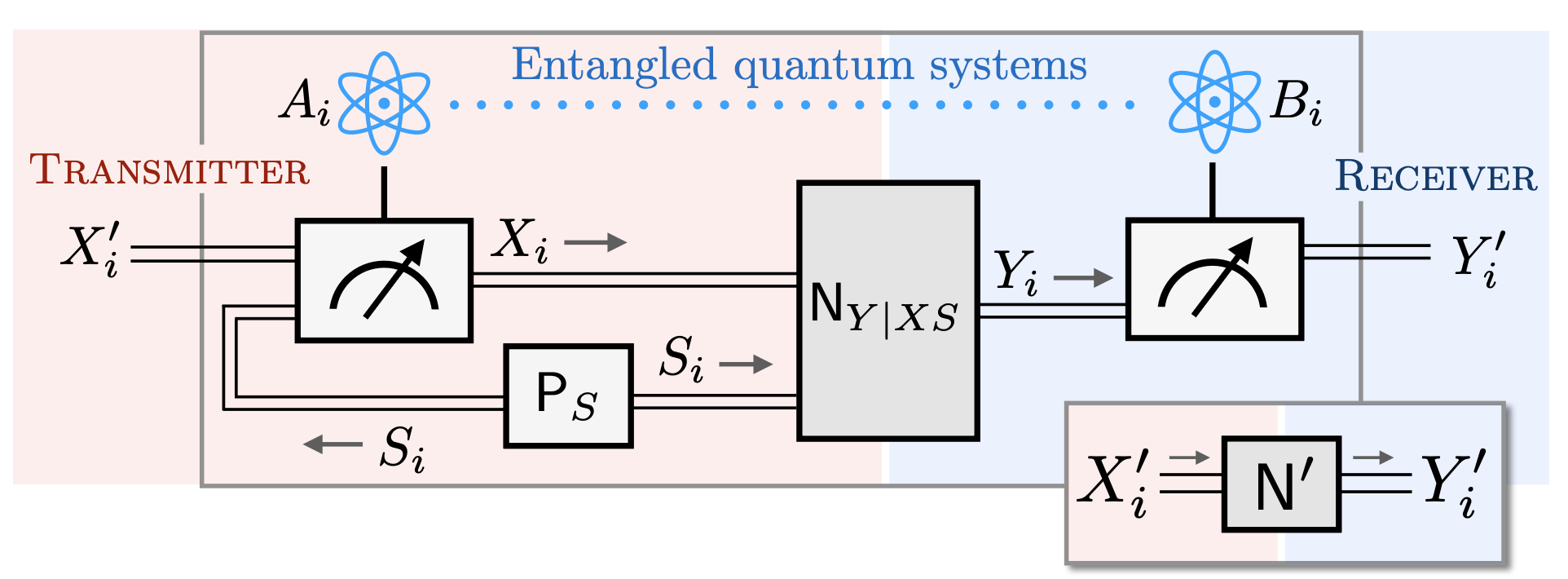
As future communication networks increasingly integrate distributed quantum resources, particularly entanglement, it is natural to explore how these resources can be leveraged within classical communication infrastructures and to quantify the advantages they can provide. We study classical channel capacity assisted by quantum entanglement. Entanglement assistance is known not to increase the capacity of classical point-to-point channels, and prior to our work, only a few multiple-access channels (MACs) were known to exhibit entanglement-assisted capacity gains, with typically modest improvements. Our results show that the picture changes significantly in the presence of causal channel state information at the transmitter (CSIT). Specifically, we show that for certain classes of state-dependent classical point-to-point channels, quantum entanglement assistance can strictly increase capacity [P2]. Moreover, for certain classes of state-dependent MACs, transmitter-side quantum entanglement assistance enables exponential and unbounded robust capacity gains [P3].
Network Information Theory with Non-Signaling Assistance
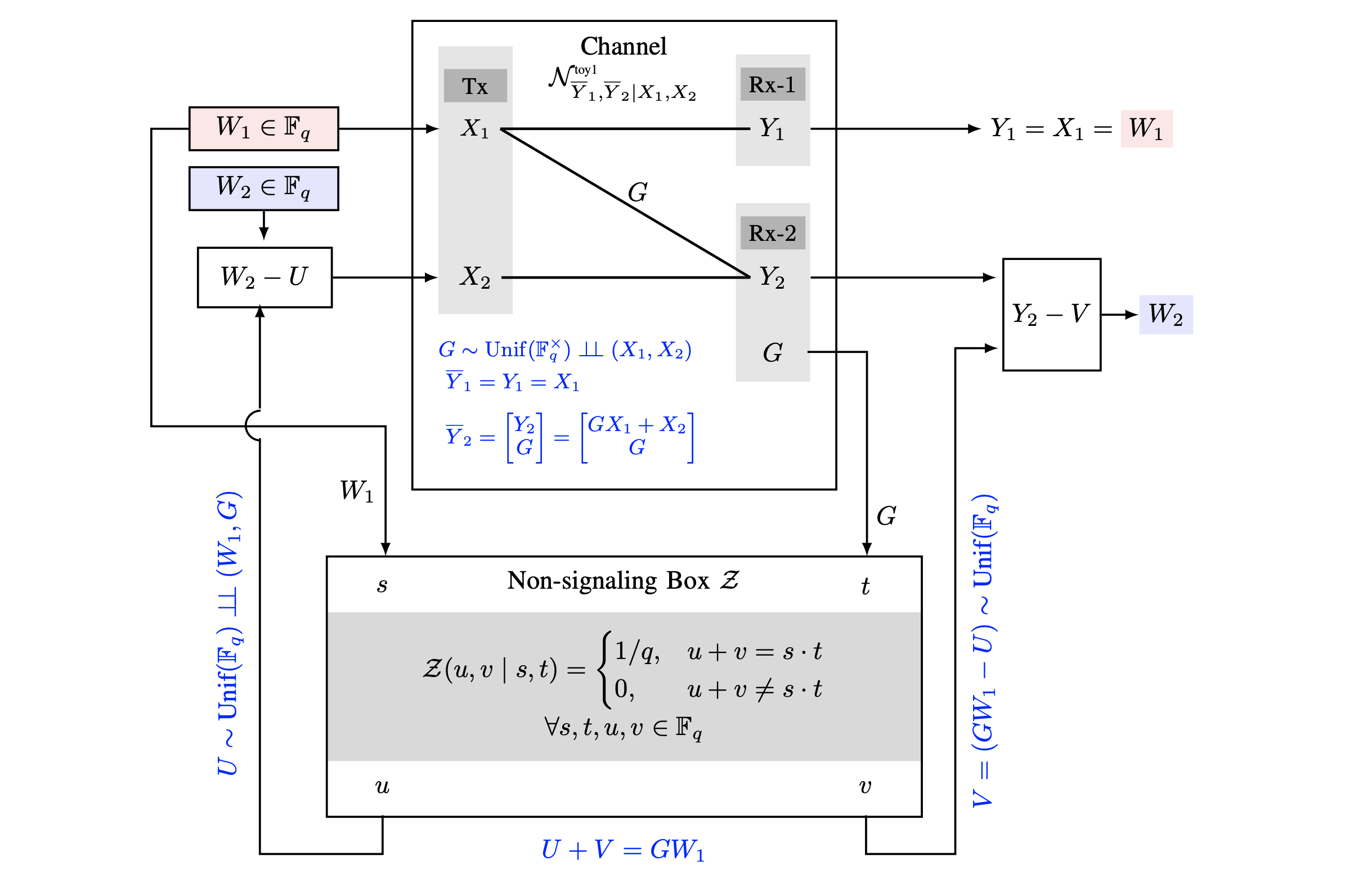
Channel capacity represents the theoretical maximum rate at which information can be reliably transmitted over a communication channel. Accordingly, determining the capacity of multi-user channels has long been one of the central objectives of network information theory. However, the classical formulation of network information theory does not account for the possibility that quantum nonlocality can generate correlations that are impossible to reproduce classically and may substantially alter the assumptions underlying communication models. As a complementary approach, non-signaling (NS) assistance offers a catch-all framework for studying the potential impact of general resources that by themselves (without the use of the channels) do not allow any communication in the network, including shared multipartite quantum entanglement. Within this framework, we characterize the NS-assisted capacities in single-letter forms for several canonical communication settings in network information theory, including point-to-point channels with state [J11, P1], broadcast channels [J10, J11, P4], and multiple-access channels [P5].
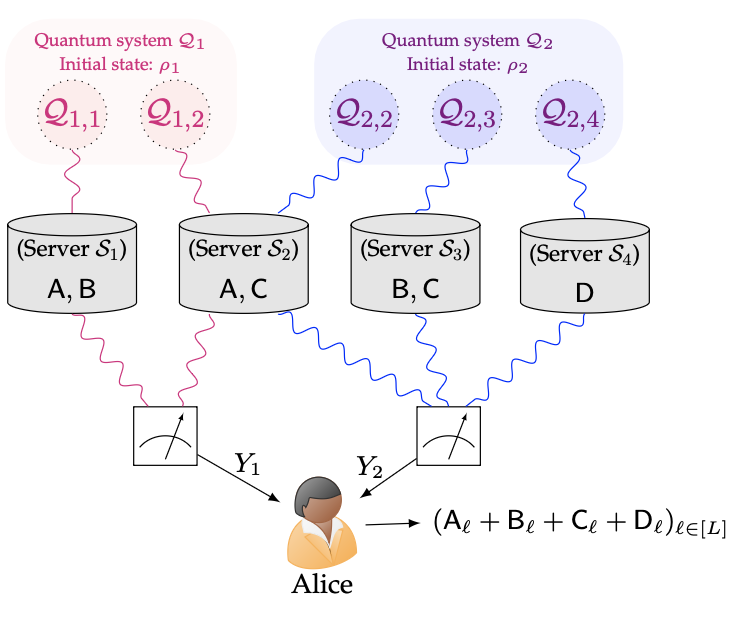
Capacity of Linear Computation over Quantum Multiple Access Channel Computation over quantum multiple access channels (MAC) is intriguing—even in the noiseless setting—because quantum entanglement enables distributed inputs to be combined and retrieved, thereby reducing the communication resources required, in a way reminiscent of over-the-air computation over wireless MACs. We study, from an information-theoretic perspective, the optimal download cost when a central node desires to retrieve a linear function by receiving quantum resources from distributed storage servers who share entanglement [J5,J9]. Furthermore, constrained entanglement patterns [J5] and the presence of erasures (stragglers) [J7] introduce additional layers of complexity and novelty, posing challenges that extend beyond those encountered in the classical counterpart.
Utility of Entanglement for Joint Communication and Instantaneous Detection in Quantum Channels
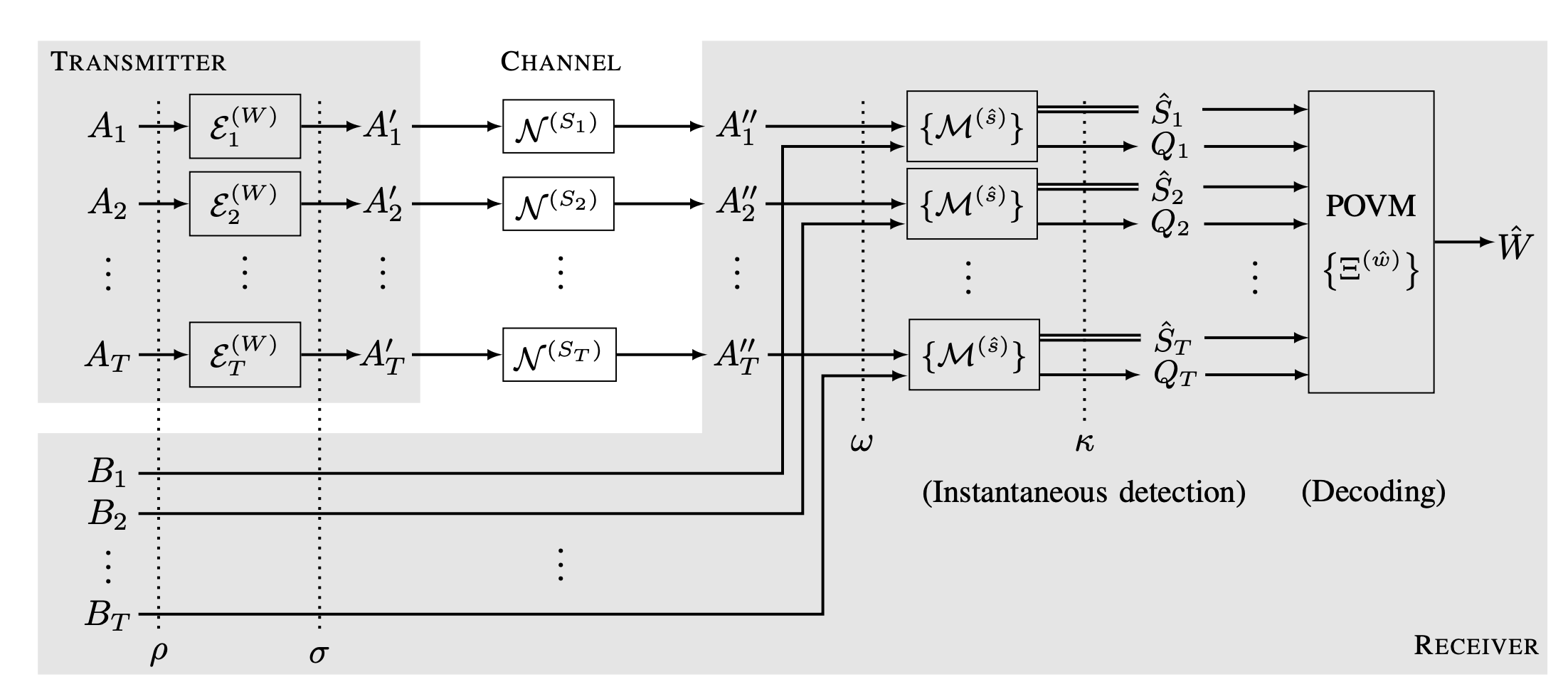
We investigate how quantum entanglement can enhance the joint performance of communication and instantaneous detection of a binary state over a noisy quantum channel, specifically one that may depolarize or erase the input with certain probabilities. By establishing a baseline of the optimal communication-detection trade-off achievable by any unentangled protocol, and by constructing an entangled protocol based on the superdense coding, we show that quantum entanglement can be simultaneously and significantly beneficial for joint communication and instantaneous detection. The results are presented in [J8].
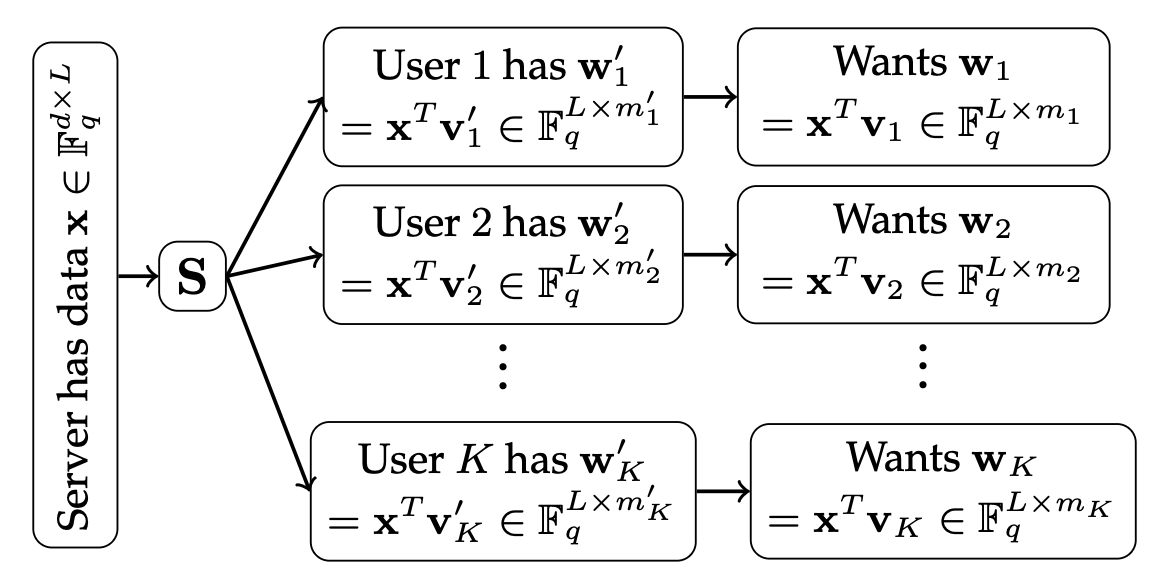
Capacity of Linear Computation Broadcast The K-user linear computation broadcast (LCBC) problem seeks the optimal broadcast cost for enabling K distributed users to compute vector linear functions of a database using their own linear side information. This framework generalizes the index coding problem in network information theory. Our work advances the study of LCBC in several directions: [J4] solves the three-user case under arbitrary demand and side-information structures, [J1] studies the setting where the server has only partial knowledge of the database, and [J3] characterizes the generic capacity of large LCBC instances. Specifically, [J3] shows that for nearly all LCBC problems with a d-dimensional dataset, $m$-dimensional demand, and m’-dimensional side information, the optimal download cost is md/(m+m’) when K ≥ d ≥ m+m'.
Publications
Preprints
Journals
Conferences
Experience
Education
2021–Present: Ph.D. in Electrical Engineering, University of California, Irvine, CA, USA
2017–2021: B.E. in Communications Engineering, Sun Yat-sen University, Guangdong, China
Teaching
Spring 2026: Teaching Assistant, EECS 50: Discrete-Time Signals and Systems, UC Irvine
Winter 2026: Teaching Assistant, EECS 152B: Digital Signal Processing Design and Laboratory, UC Irvine
Selected Honors
SSoE Outstanding Ph.D. Student Research Award (2025), Samueli School of Engineering, UC Irvine
Outstanding Graduate (2021), Sun Yat-sen University